10 Research-Backed Ways Parents Can Support Their Child's Learning at Home
By CMR School, Lalgadi Malakpet
Your child's school does a great deal — but research consistently shows that a child's academic outcomes are significantly shaped by what happens at home. The good news? Supporting your child's learning does not require you to be a teacher, to spend hours on homework every evening, or to invest in expensive tuition.
This guide covers practical, research-backed ways Hyderabad parents can support their children's learning at home — especially during the primary and middle school years.
Why Home Learning Environments Matter
Decades of education research show that children perform better when:
- Parents show genuine interest in what they are learning at school
- The home environment is orderly, predictable, and calm — especially during study time
- Conversation at home is rich — discussions about books, news, nature, and ideas
- Screens are managed thoughtfully rather than used as default entertainment
- Reading is modelled — children who see parents reading are far more likely to read themselves
None of these require a postgraduate degree. They require attention, consistency, and intention.
10 Practical Ways to Support Your Child's Learning at Home
1. Create a Dedicated Study Space
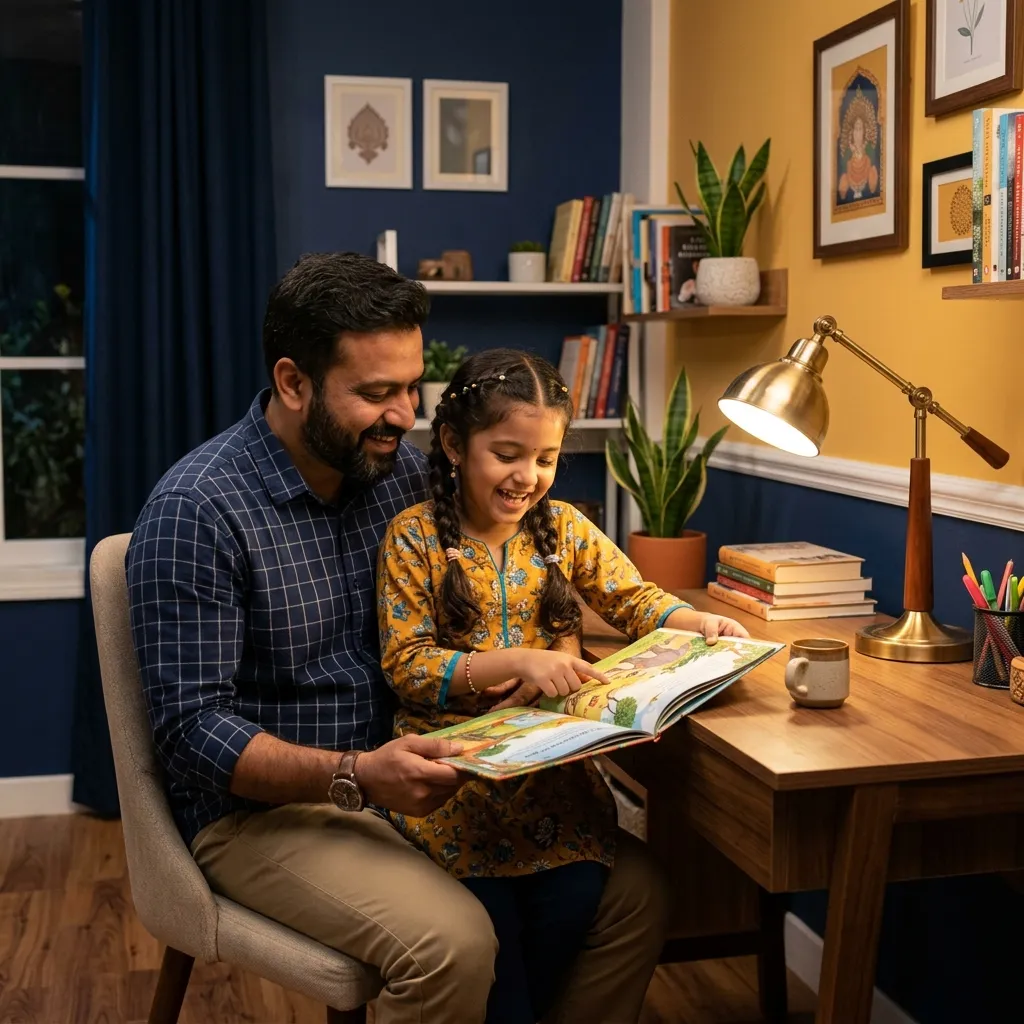
Children do better with a fixed, clutter-free, well-lit spot for homework and reading. It does not need to be a separate room — a consistent corner of a table with good light and no screen distractions is enough. The key is consistency: this is where study happens.
2. Establish a Daily Routine
Children thrive with predictable routines. A simple schedule — school, rest, snack, study, dinner, sleep — helps their brain shift between modes. Homework done at the same time each day requires less willpower from the child (and you).
3. Read Aloud Together — At Any Age
Many parents stop reading aloud when children can read independently. This is a mistake. Reading aloud to children up to age 12 (and beyond) builds vocabulary, comprehension, and imagination in ways silent reading alone cannot. Twenty minutes before bed is enough.
4. Ask "What Did You Learn Today?" — Not "How Was School?"
"How was school?" invites "fine." "What's the most interesting thing you learned today?" invites a conversation. If your child is studying fractions, ask them to explain it to you. The act of explaining a concept reinforces it more powerfully than reviewing notes.
5. Reduce Screen Time Strategically
Screens are not the enemy — unmanaged screens are. The clearest research finding is that passive screen time (scrolling, watching) should be limited, while interactive or creative use (educational games, projects) is less harmful. A simple rule: no screens during study time, and screens earned after responsibilities are done.
6. Show Interest in Their Subjects — Even If You Find Them Dull
Your child can tell when you are genuinely interested versus performing interest. Pick one subject per term and engage with it: visit a museum, watch a documentary, cook a recipe related to a geography lesson. This kind of connected learning is enormously motivating.
7. Attend PTMs and Stay in Touch with Teachers
Parent-Teacher Meetings are not just a chance to collect a report card. They are an opportunity to understand how your child shows up in a school context — which may be quite different from home. Come prepared with specific questions, not just general "how is my child doing?"
8. Let Your Child Struggle a Little
The instinct to jump in and rescue your child from a difficult maths problem is completely natural — and counterproductive. Research on learning consistently shows that productive struggle — working through a challenge before getting help — builds deeper understanding and resilience. Wait. Watch. Prompt with questions. Only then assist.
9. Celebrate Effort, Not Just Results
Carol Dweck's decades of research on growth mindset show clearly that children who are praised for effort ("you worked so hard on that") develop more resilient, curious learners than those praised only for intelligence ("you're so smart"). When a test doesn't go well, the conversation should be about what to do differently — not about the mark itself.
10. Prioritise Sleep
Sleep is the single most underrated academic intervention available to parents. Children who consistently get enough sleep have significantly better memory consolidation, attention, and emotional regulation. Primary school children need 9–11 hours; middle school children need 8–10 hours. Protect this — it is more important than one more hour of homework.
Working with Your Child's School
The most effective support for your child combines what you do at home with what their school does in the classroom. At CMR School, Lalgadi Malakpet, we actively encourage parents to stay involved — through regular PTMs, our parent portal, and an open-door approach with our academic team.
If you have concerns about your child's learning at any point, please reach out to our team directly. The school–home partnership is at the heart of what we do.
Frequently Asked Questions
Should I hire a private tutor for my child in primary school?
This depends on the child. If your child is genuinely struggling with a specific concept, targeted support can help. However, many parents hire tutors pre-emptively, which can reduce a child's independent learning capacity. Start with the school — ask the teacher what specific support is needed before going external.
How much homework should my primary school child have?
Many education experts suggest 10 minutes per grade level per night is appropriate (10 minutes for Class I, 20 for Class II, and so on). Research does not support heavy homework loads for children under age 10. If your child is spending more than this, it is worth a conversation with the school.
My child refuses to do homework. What should I do?
Refusal is usually about something — anxiety, boredom, difficulty, or a power struggle. The most effective approach is calm, consistent structure (homework happens at a set time) combined with genuine curiosity about what is making it hard. Avoid power struggles, which rarely end well for anyone.
Is it okay for parents to do homework with their children?
Doing homework with your child — sitting alongside, asking questions, being available — is wonderful. Doing homework for your child is harmful. The goal of homework is practice and consolidation; if a parent completes it, no learning happens.
Conclusion
Supporting your child's learning at home is less about academic drilling and more about creating an environment of curiosity, calm, and care. The simple daily habits in this guide — reading together, maintaining routines, protecting sleep, and genuinely engaging with your child's school life — make an outsized difference over time.
At CMR School, Lalgadi Malakpet, we see families as partners in every child's education. Learn more about our approach or explore admissions for 2026-27.
Estimated read time: 6 minutes