Why Mental Maths and Abacus Training Build Cognitive Strength
By CMR School, Lalgadi Malakpet
Numbers do not have to be flat symbols on a page; they can be dynamic tools that jump to life in a child's mind. At CMR School, Lalgadi Malakpet, we transform mathematics from a subject of memorization into a playground of cognitive exploration.
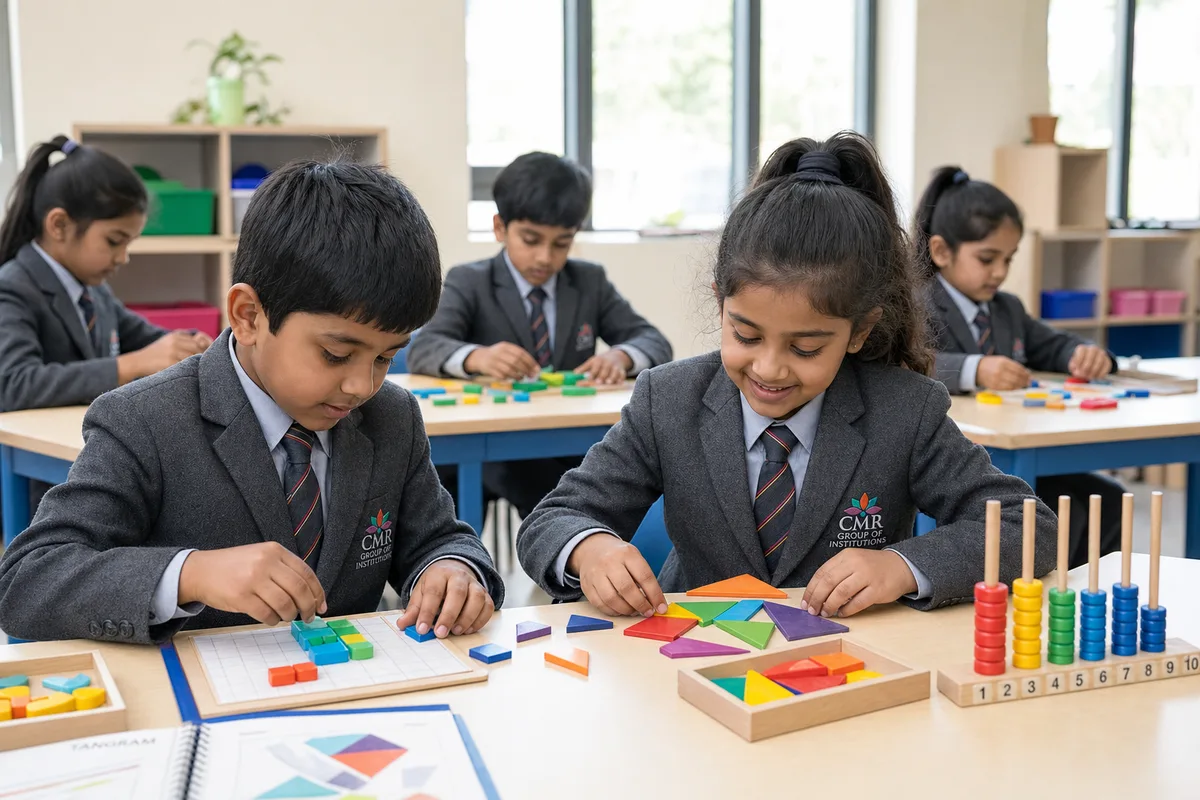
Unlocking numerical agility — students using abacus frames and hands-on tools during a session at the CMR School Math Lab.
For many students, mathematics represents a significant source of academic stress. Traditional teaching methods often focus on paper-and-pencil calculations, which can feel abstract and disconnected. By integrating abacus training for kids and structured mental maths benefits, we help students build spatial awareness, logical reasoning, and a genuine love for numbers that serves them throughout their education.
The Cognitive Science of Abacus Training
An abacus is not just an ancient calculator; it is a powerful tool for visual-spatial development. When children slide beads along wires, they translate abstract mathematical concepts into tactile, physical experiences. Over time, students internalize the abacus, allowing them to perform complex calculations mentally by visualizing the beads moving, which stimulates both left and right brain hemispheres.
Key Mental Maths Benefits for Growing Minds
Learning to calculate mentally offers advantages that go far beyond fast test scores:
1. Sharper Memory and Attention
Mentally keeping track of numbers during multi-step operations requires sustained concentration, building working memory capacity and focus.
2. Faster Problem Solving
When basic arithmetic becomes automatic, the brain has more energy to focus on higher-level problem-solving and word problems in the CBSE syllabus.
3. Elevated Academic Confidence
Being able to add, subtract, or multiply quickly in their heads gives students a sense of numerical mastery, reducing general math anxiety.
4. Everyday Practical Application
From estimating shopping costs to dividing pizza, mental calculation is a direct, practical skill that children use every single day.
Hands-On Learning in Our Mathematics Laboratory
At CMR School, we bring calculations to life through interactive math lab activities. Rather than working in isolation at their desks, students gather around math puzzles, play group math games, and build geometric shapes. This collaborative, hands-on approach removes the fear of failure and demonstrates that mathematics is about finding patterns, not just finding the single correct answer.
How Parents Can Foster Mental Math at Home
You can easily build numerical thinking through daily household routines. Turn grocery shopping into a game by asking your child to estimate the total cost or calculate the change. Play board games that involve dice, like Monopoly or Ludo, which require constant addition and subtraction. Ask open-ended questions like "If we have six guests and eight slices of cake, how can we share them?" to help them practice math reasoning in real-world scenarios.
Conclusion
Building cognitive strength starts with making learning tactile and active. Through our abacus training and interactive laboratory sessions, we ensure that our students develop the reasoning power and confidence to excel. At CMR School, Lalgadi Malakpet, we make sure mathematics is a journey of discovery.
Enquire About Admissions 2026-27 — CMR School, Lalgadi Malakpet
Admissions are open for the academic year 2026-27 (Nursery to Class VIII). Book your campus visit or fill out an online enquiry today.
Apply Now →Frequently Asked Questions (FAQs)
1. What is the best age to start abacus training for kids?
The ideal window is between ages 5 and 12. During this period, a child's brain is highly adaptable, and concrete operational thinking is developing, making it easier to connect tactile movements with mathematical concepts.
2. Does mental math speed help in CBSE board examinations?
Absolutely. While CBSE board exams test concepts and reasoning, quick calculation skills save valuable time during physics, chemistry, and mathematics exams, leaving more time for revision and difficult questions.
3. How do math lab activities differ from regular classroom teaching?
Regular classes focus on concepts, definitions, and problem-solving. Math lab activities involve games, tactile models, and puzzles, allowing students to physically manipulate objects to see how formulas work.
4. Will my child get confused between abacus methods and regular school math?
No. Abacus training builds underlying numerical understanding. Rather than contradicting school mathematics, it serves as a visual framework that makes school methods like long division and fractions much easier to grasp.
Estimated read time: 5 minutes