The Role of Puppetry and Role Play in Enhancing Preschool Vocabulary
By CMR School, Lalgadi Malakpet
Language learning should not be a chore of repeating words; it should be an adventure where characters tell stories. At CMR School, Lalgadi Malakpet, we bring language to life for our youngest students through theater, puppets, and role play.
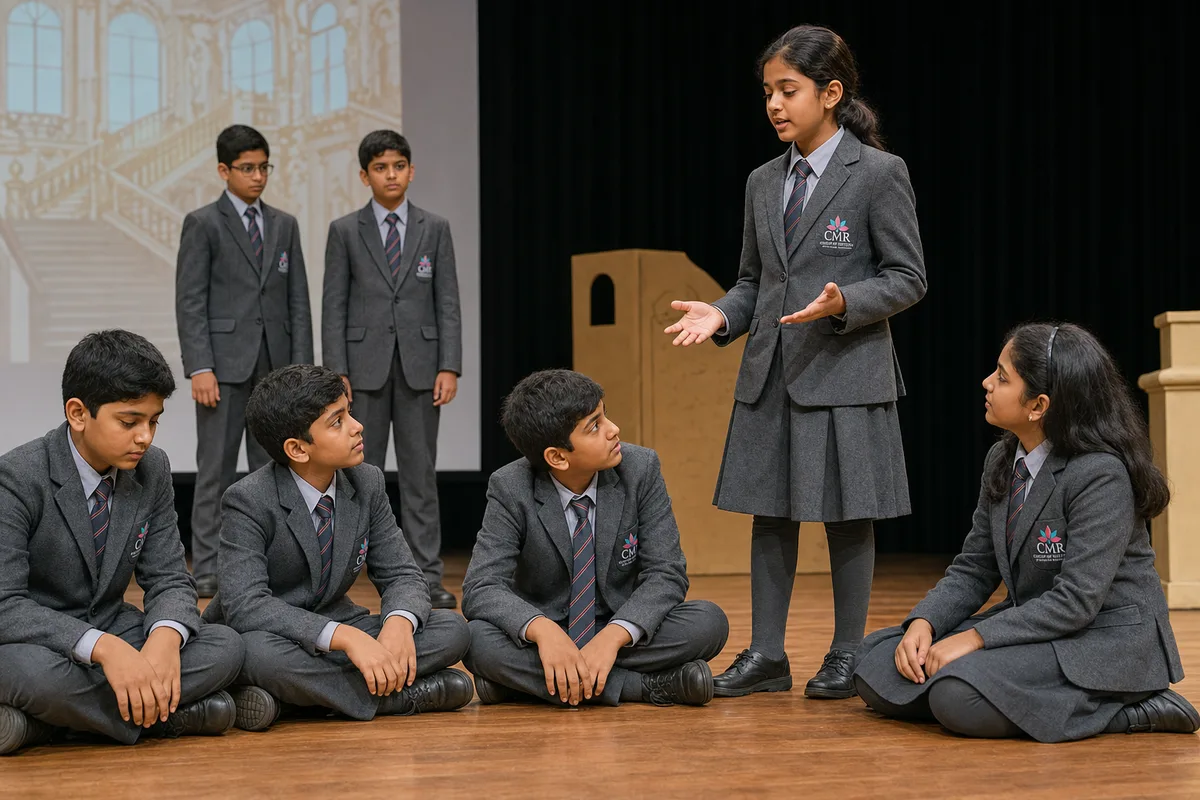
Imagination in speech — preschool students participating in a puppet show storytelling session to build vocabulary.
For young children, words are tools to express their desires, feelings, and observations. Memorizing vocabulary lists from a chart is rarely effective because it lacks context. Through structured play-based learning vocabulary and puppetry in early education, we create situations where children use new words naturally to tell stories and communicate, accelerating language development pre-primary.
Why Puppets and Role Play are Magic for Language Development
Puppets act as a safe, low-pressure bridge for communication. A shy child who refuses to speak to an adult will often whisper secrets to a hand puppet. When a child steps into a character's shoes during role play, they feel safe to experiment with sounds, tone, and new vocabulary without fear of making mistakes.
How CMR School Integrates Puppetry and Play-Based Language Learning
We weave dramatic play into our early education curriculum. Here are the methods our pre-primary teachers use:
1. Weekly Puppet Theater Stories
Teachers use hand and finger puppets to act out stories, introducing new words in context. For example, a puppet might be "exhausted" instead of just "tired," showing children how to expand their vocabulary.
2. Themed Role-Play Corners
Classrooms feature rotating play spaces like a grocery store, a doctor's clinic, or a space station. Students take turns acting as customers, doctors, or astronauts, using theme-specific words naturally.
3. Interactive Storytelling Circles
During story time, children hold puppets and help tell the story. They decide what the characters say next, practicing sentence structure, verbs, and descriptive words.
4. Emotion Role-Playing Games
We use puppets to act out different emotional scenarios, helping children identify and talk about complex feelings like frustration, excitement, and envy.
How Parents Can Use Puppetry and Dramatic Play at Home
You can easily build language skills at home using simple dramatic play. You don't need expensive toys; a clean sock with buttons for eyes makes a perfect puppet. Use the puppet to discuss daily routines, or play "doctor" or "shopkeeper" using household items as props. Read books together and act out the characters' actions, using different voices for each character. This active participation connects words with physical experiences, making vocabulary learning memorable and fun.
Conclusion
Language is the key that unlocks a child's mind. By encouraging puppetry and dramatic play in our preschool rooms, we ensure our pre-primary students develop rich vocabularies and the confidence to express themselves clearly. At CMR School, Lalgadi Malakpet, we make early years learning a joyful experience of discovery.
Enquire About Admissions 2026-27 — CMR School, Lalgadi Malakpet
Admissions are open for the academic year 2026-27 (Nursery to Class VIII). Book your campus visit or fill out an online enquiry today.
Apply Now →Frequently Asked Questions (FAQs)
1. How do puppets help build play-based learning vocabulary?
Puppets provide immediate context. When a puppet acts out a word like "terrified" or "gigantic" during a story, children see the meaning, making it easier for them to remember and use the word correctly in conversation.
2. My child prefers to play quietly alone. Should I force them into role play?
No. Never force participation. Let them observe first. You can hand them a puppet and play next to them. Often, quiet children will begin talking through their puppet when they see there is no pressure on them directly.
3. At what age is role-playing most effective for language development pre-primary?
Dramatic and pretend play begins to develop around age 2 and peaks between ages 3 and 6, aligning perfectly with the preschool years when vocabulary and social-emotional skills are growing rapidly.
4. Can digital media or educational videos replace role-playing?
No. Videos are passive experiences. Language development requires back-and-forth interaction. Role-playing is active, requiring children to listen, respond, think, and use muscles to speak, which builds stronger neural connections.
Estimated read time: 5 minutes