Role of Interactive Experiments in Biology: Cultivating Environmental Connection
By CMR School, Lalgadi Malakpet
Understanding the natural world requires more than looking at diagrams of cells and food webs. At CMR School, Lalgadi Malakpet, we bring biology to life through structured laboratory exploration and campus sustainability projects.
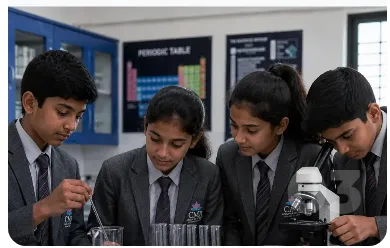
Connecting science and nature — students examining plant specimens under microscopes during a biology lab experiment.
A textbook can describe photosynthesis and plant anatomy, but nothing matches the experience of extracting DNA from a strawberry, observing single-celled organisms in pond water, or monitoring the life cycle of a plant. By integrating biology lab experiments with environmental education in school, we help students build scientific literacy, analytical thinking, and a lifelong appreciation for the planet.
Why Interactive Labs are Vital for Biology Education
Biology is the science of life, and studying it must be active. Active observation turns abstract descriptions into real-world insights. When students use microscopes, dissect flowers, or analyze soil samples, they learn the scientific method firsthand, which is a key priority for the science curriculum CBSE.
How CMR School Connects Biology and Environmental Stewardship
Our biology curriculum extends beyond the laboratory walls into our school gardens and composting zones. Here is how we connect theory with practical action:
1. Microscopic Exploration
Students learn to prepare slides and use microscopes to examine plant tissues, yeast cells, and stomata. This builds technical skills and precision early.
2. Soil and Water Quality Testing
Students analyze campus soil and water samples, testing pH levels and mineral content. This teaches them how environmental factors directly impact plant growth.
3. School Garden and Herbarium
Classes maintain a school garden, observing seed germination, pollination, and insect-plant interactions. Students compile herbarium files of local medicinal plants.
4. Campus Waste and Composting Audit
Biology classes manage our organic waste composting bins, studying decomposers, nutrient cycles, and waste management practices in real time.
How Parents Can Foster Biological Curiosity at Home
You can easily build biological curiosity through simple, everyday activities. Start a small balcony or kitchen garden where your child can plant coriander, mustard, or mint seeds, keeping a daily observation journal. Take a magnifying glass on walks to examine tree bark, leaf veins, and insects close up. Discuss where food comes from, composting kitchen scraps, and conservation habits at home. This turns environmental responsibility from a textbook lesson into a daily family practice.
Conclusion
The biology lab is a bridge between scientific concepts and environmental stewardship. By welcoming inquiry-based experiments and hands-on green initiatives, we help our students grow into critical thinkers ready to protect our future. At CMR School, Lalgadi Malakpet, our biology sessions ensure that every student builds a deep, practical understanding of life science.
Enquire About Admissions 2026-27 — CMR School, Lalgadi Malakpet
Admissions are open for the academic year 2026-27 (Nursery to Class VIII). Book your campus visit or fill out an online enquiry today.
Apply Now →Frequently Asked Questions (FAQs)
1. Are biology lab experiments safe for primary school children?
Yes. All primary school experiments use non-toxic, everyday materials (like food items, leaves, and yeast). Lessons are conducted under strict teacher supervision, and safety measures are taught before any hands-on activity begins.
2. How does environmental education in school benefit students?
Environmental education builds critical thinking, problem-solving, and civic responsibility. It helps children understand the ecological consequences of human actions, preparing them to contribute to a sustainable future.
3. What scientific skills does biological lab work develop?
It develops manual dexterity (using pipettes and slide preparation), precision in measurement, objective observation, data recording, graphing, and the logical deduction required to compile scientific reports.
4. Does CBSE focus on practical assessments in middle school?
Yes. The science curriculum CBSE includes practical assignments, project work, and internal assessments. Fostering lab comfort early prepares students to perform confidently in board exams and competitive entries.
Estimated read time: 5 minutes