How Art and Craft Activities Strengthen Fine Motor Skills in Preschoolers
By CMR School, Lalgadi Malakpet
Holding a pencil, buttoning a shirt, and using safety scissors require thousands of tiny muscle movements. At CMR School, Lalgadi Malakpet, we strengthen these fine motor skills through creative, play-based art and craft projects.
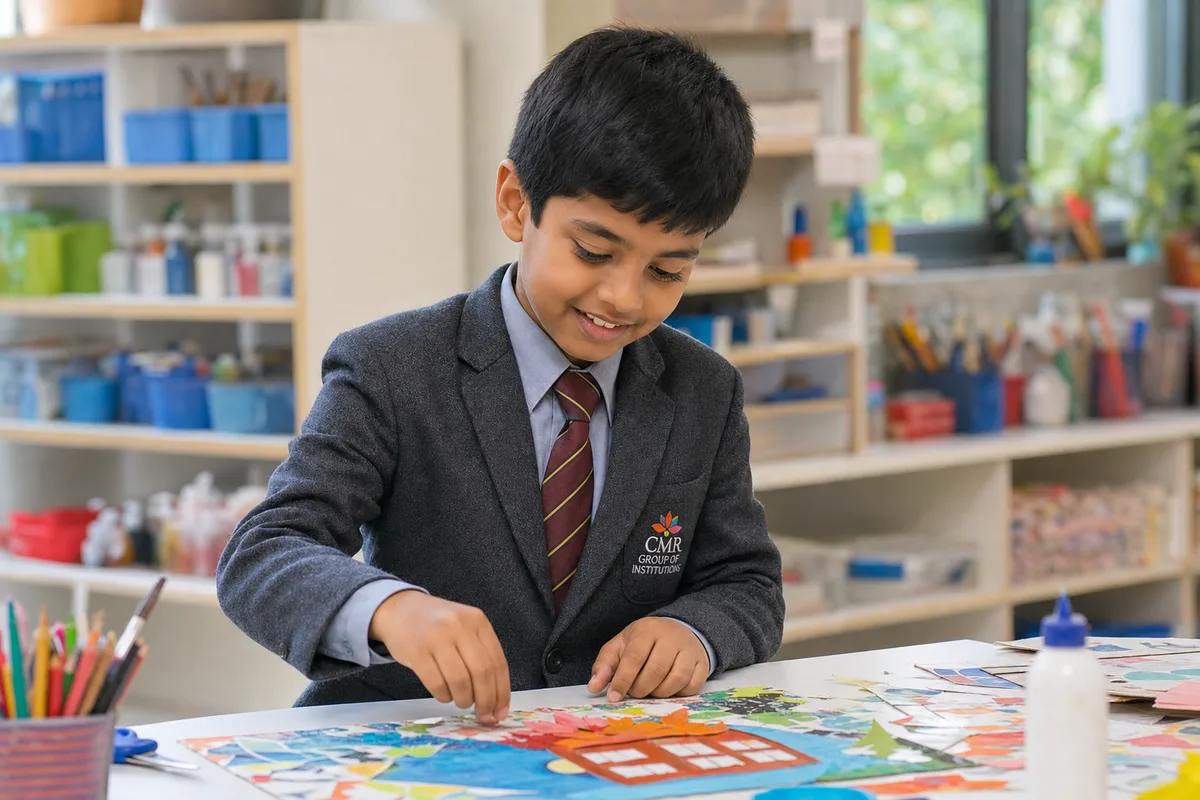
Crafting confidence — young students using safety scissors and clay to create models in a preschool classroom.
For parents, early childhood education can sometimes seem focused entirely on reading letters and counting numbers. However, before a child can write a single letter, they must develop the hand strength, finger coordination, and spatial awareness to control a writing tool. Creative fine motor skills activities like painting, cutting, and clay modeling are crucial for preparing young fingers for academic success.
Why Fine Motor Skills are Critical for School Readiness
Fine motor skills involve the coordination of small muscles in the hands and fingers, in synchronization with the eyes. If these muscles are weak, children struggle with writing, leading to hand fatigue and frustration during early primary years. Integrating structured preschool art and craft into early education is the most natural, stress-free way to build this essential physical foundation.
How CMR School Builds Hand Strength and Coordination
In our pre-primary classrooms, art and craft are treated as vital developmental tools. Here is how we design our daily motor skills activities:
1. Playdough and Clay Modeling
Squeezing, rolling, and pinching clay is like a gym workout for small hands. It strengthens the arches of the hands and builds finger independence.
2. Safety Scissor Practice
Cutting paper requires students to use two hands cooperatively, coordinating their eyes with their hands and strengthening the muscles that control pencil grip.
3. Beading, Lacing, and Threading
Threading beads on a string or lacing cards requires precise pincer grasp (using index finger and thumb) and builds concentration and patience.
4. Painting, Gluing, and Collage Making
Using paintbrushes, squeezing glue bottles, and tearing paper into small pieces for collages develop finger dexterity and sensory awareness.
Playful Fine Motor Skills Activities for Families at Home
You can easily support finger coordination at home using everyday household items. Let your child help with kitchen tasks like shelling peas, kneading dough, or tearing lettuce leaves. Set up a sensory bin filled with raw rice, pasta, or beans, and give them spoons and cups to practice scooping and pouring. Provide safety scissors and old magazines to cut out pictures, or play with building blocks and LEGOs together. These fun activities build hand strength naturally, without making it feel like a chore.
Conclusion
Creative play is the work of early childhood. By prioritizing art, craft, and tactile play in our curriculum, we ensure our pre-primary students build the physical coordination and confidence to succeed in writing and beyond. At CMR School, Lalgadi Malakpet, we are proud to offer an early education that nurtures every part of a child's development.
Enquire About Admissions 2026-27 — CMR School, Lalgadi Malakpet
Admissions are open for the academic year 2026-27 (Nursery to Class VIII). Book your campus visit or fill out an online enquiry today.
Apply Now →Frequently Asked Questions (FAQs)
1. What are the signs of weak fine motor skills in preschoolers?
Signs include struggling to hold a pencil, difficulty using safety scissors, avoiding drawing or coloring, struggling with buttons, zippers, or open-close food containers, and tire quickly during hand-focused games.
2. Does fine motor development influence intellectual growth?
Yes. Early motor control is closely linked to cognitive development. As children manipulate objects, build puzzles, and create crafts, they learn spatial relations, problem-solving, and coordinate their thoughts with physical actions.
3. My child wants to use screen apps instead of drawing. What should I do?
Limit screen time. Swiping on a tablet does not build the muscle strength or manual dexterity required to write. Replace screens with tactile toys like playdough, sand, blocks, and finger paints that encourage active finger use.
4. How do teachers support left-handed children with fine motor activities?
Our teachers provide left-handed safety scissors, teach proper hand positioning to avoid smudging, and ensure left-handed students sit on the left side of tables so their elbows do not clash with right-handed peers during writing and crafts.
Estimated read time: 5 minutes