Building Strong Reading Comprehension Skills Beyond Decoding Words
By CMR School, Lalgadi Malakpet
Knowing how to pronounce a word is only the first step of reading; the real magic happens when a child understands the story behind the words. At CMR School, Lalgadi Malakpet, we guide our students to become active, analytical readers.
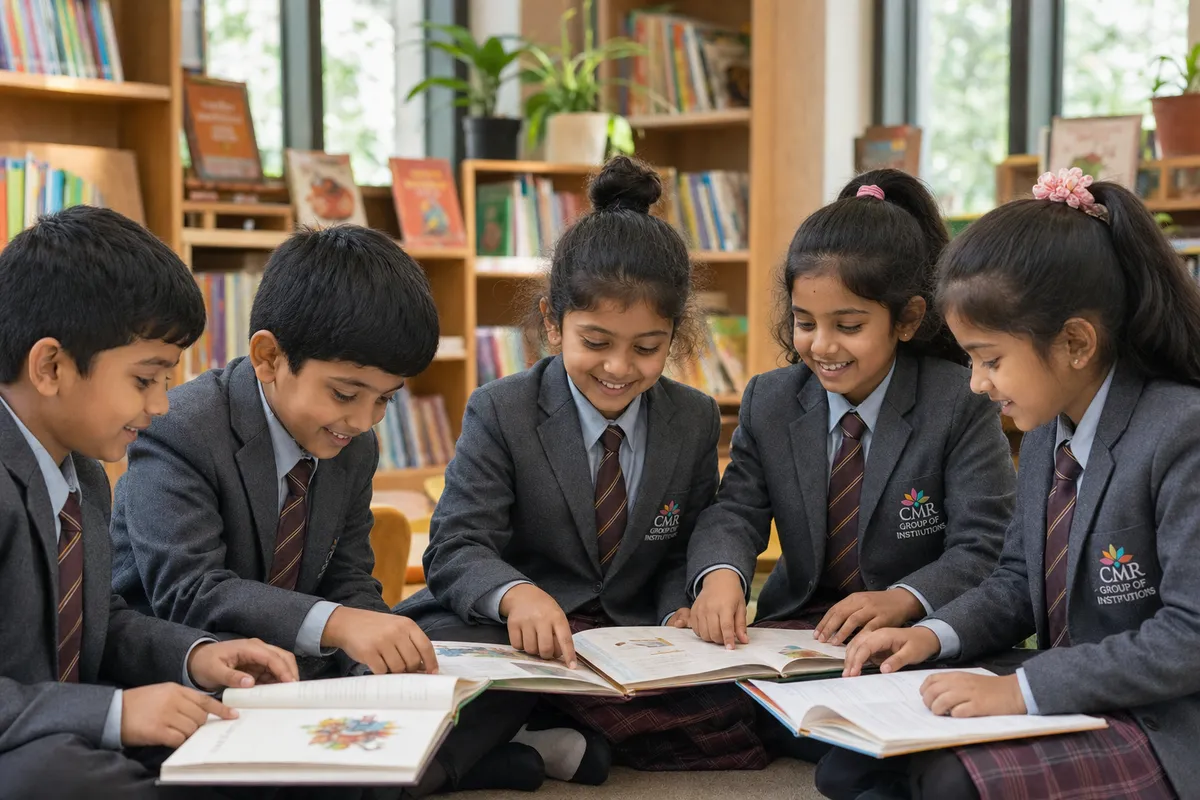
Immersed in discovery — students engaged in a quiet reading and discussion session inside the school library.
Many children learn to read aloud fluently at an early age, decoding letter sounds perfectly. However, parents are often surprised to find that when asked what the story was about, the child cannot explain it. Reading comprehension skills do not develop automatically; they must be taught through active strategies, which are critical for success in CBSE English learning and subsequent analytical subjects.
Why Reading Comprehension Matters More Than Speed
Reading comprehension is the ability to process text, understand its meaning, and integrate it with what the reader already knows. It is what transforms reading from a mechanical task into a tool for learning history, science, and literature. Building strong reading habits early ensures that students can digest long texts and answer analytical, competency-based questions in their examinations.
How CMR School Builds Deep Reading Comprehension
Our literature and library programs are designed to make reading active and analytical. Here are the core methods we use daily:
1. "Active Reading" Guided Discussions
During reading sessions, our teachers stop periodically to ask predictive and analytical questions: "Why do you think the character made that choice?" or "What do you predict will happen next?" This keeps students engaged with the meaning of the text.
2. Concept and Story Mapping
Students use visual charts to map out the setting, characters, problem, and solution of a story. This visual framework helps them organize and remember details.
3. Vocabulary in Context
Rather than memorizing definitions, we encourage students to guess the meaning of new words using clues from the surrounding sentences, which builds analytical reasoning.
4. Diverse Genre Exploration
Our library offers a wide range of fiction, biography, science books, and news articles, helping children build the background knowledge required to comprehend different writing styles.
How Parents Can Strengthen Comprehension Skills at Home
You can easily build deep reading habits through your home routines. When reading books together, turn it into a discussion: pause occasionally and ask "Why do you think she did that?" or "How would you feel if you were in their shoes?" After finishing a chapter, ask your child to summarize the events in their own words: "Can you tell me what happened in three sentences?" Talk about new words you encounter, relating them to experiences they know. This interactive, conversational approach shows children that reading is about discovering ideas, not just sounding out letters.
Conclusion
True reading is a dialogue between the reader and the text. By encouraging active questioning, visual mapping, and context-based learning, we help our students grow into critical, independent readers. At CMR School, Lalgadi Malakpet, our English language programmes ensure that every student builds the comprehension power to succeed in a complex world.
Enquire About Admissions 2026-27 — CMR School, Lalgadi Malakpet
Admissions are open for the academic year 2026-27 (Nursery to Class VIII). Book your campus visit or fill out an online enquiry today.
Apply Now →Frequently Asked Questions (FAQs)
1. What is the difference between word decoding and reading comprehension skills?
Word decoding is the physical ability to sound out and pronounce words. Reading comprehension is the cognitive ability to understand the meaning, connections, and underlying message of the text.
2. How can I help my child improve reading habits if they find books boring?
Start with topics they already love (like dinosaurs, sports, or outer space) and try different formats like comic books, illustrated guides, or magazines. Read with them and discuss the pictures, making it an interactive experience.
3. Does background knowledge influence reading comprehension?
Yes, significantly. A child who already knows about volcanoes will find a science text about lava much easier to comprehend than a child who has never heard of them. Exploring diverse topics builds the background knowledge that supports reading.
4. How does CBSE evaluate comprehension in English exams?
The CBSE English learning framework uses unseen passages, requiring students to answer analytical, direct, and inference-based questions. Fostering deep comprehension habits early prepares students to tackle these sections confidently.
Estimated read time: 5 minutes